BJJ vs Karate, Taekwondo, and Other Martial Arts Compared
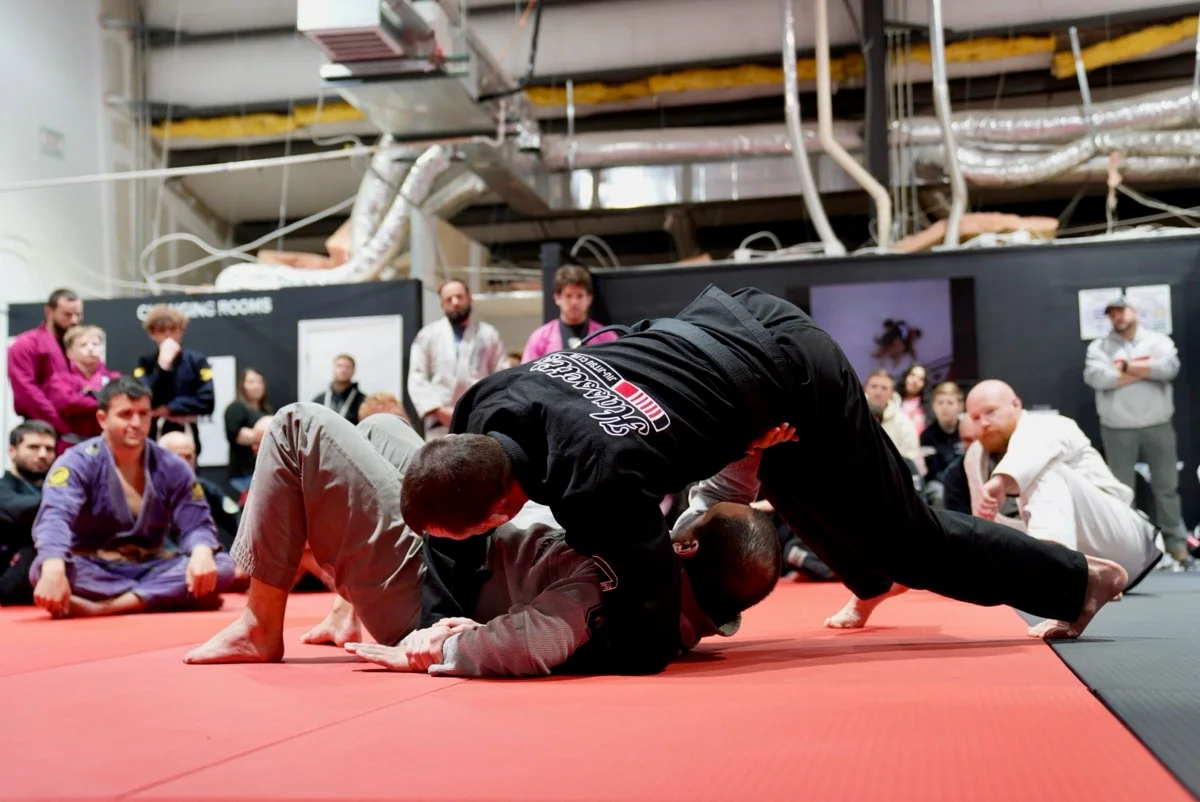
BJJ vs Karate, Taekwondo, and Other Martial Arts Compared
A UFC Veteran's Breakdown of How Brazilian Jiu-Jitsu Stacks Up Against Other Fighting Styles
If you're researching martial arts in Gastonia or the Charlotte area, you've probably noticed there are a lot of options: BJJ vs karate, taekwondo, boxing, Muay Thai, judo. Each one makes big promises. Each one has loyal followers who swear it's the best. So how do you actually decide?
I'm going to give you an honest answer. I've spent over 20 years in martial arts, competed in the UFC against fighters from every background imaginable, and now I run Solecki BJJ here in Gastonia, NC. I've trained with world-class strikers, wrestlers, and grapplers. I've been hit by karate guys, kicked by taekwondo black belts, and submitted by some of the best jiu-jitsu players on the planet.
So I'm not going to trash other martial arts. They all have value. But I am going to be straight with you about what each style does well, where it falls short, and why I believe BJJ is the most complete martial art for most people. If you want to understand what BJJ actually is before diving into comparisons, start there.
How I'm Comparing These Martial Arts
Rather than just listing opinions, I'm going to compare each art across five categories that matter most to everyday people:
- Self-defense effectiveness -- Can you actually use this in a real situation?
- Fitness and conditioning -- What kind of workout are you getting?
- Accessibility for beginners -- How easy is it to start with zero experience?
- Competition opportunities -- Can you test yourself if you want to?
- Real-world effectiveness -- How does it hold up outside the gym?
Let's break it down.
BJJ vs Karate
Karate teaches discipline, respect, and a solid foundation in striking. Traditional karate emphasizes forms (kata), linear strikes, and blocks. Some styles like Kyokushin incorporate full-contact sparring and are genuinely tough.
But here's the reality: most karate schools don't train with full resistance. You're practicing techniques against cooperative partners or in the air. When things get chaotic in a real self-defense situation, that gap matters.
BJJ is built on live sparring from day one. Every class at our academy, you're rolling with a resisting partner. You know your techniques work because you've tested them against someone actively trying to stop you.
The other issue is range. Karate works at punching and kicking distance, but most real confrontations close that distance fast. Once someone grabs you or takes you down, karate doesn't give you many answers. BJJ starts exactly where karate stops.
Where karate wins: Stand-up discipline, traditional values, striking fundamentals for kids.
Where BJJ wins: Live sparring culture, ground control, practical self-defense at close range.
BJJ vs Taekwondo
Taekwondo is an Olympic sport known for spectacular high kicks and fast footwork. It's accessible for kids with structured belt systems and a strong emphasis on discipline.
However, jiu jitsu vs taekwondo is not close when it comes to self-defense. Taekwondo is heavily focused on head kicks and point-scoring. The stances are narrow and bladed, leaving you vulnerable to takedowns.
I've fought taekwondo practitioners in MMA. Their kicks can be dangerous at distance, but once you close the gap, the fight changes completely. On the ground, taekwondo gives you nothing to work with.
For fitness, taekwondo is excellent. But BJJ gives you a full-body workout that also builds functional strength, grip endurance, and core stability -- fitness that translates to real life.
Where taekwondo wins: Flexibility development, kicking ability, Olympic competition pathway.
Where BJJ wins: Close-range self-defense, ground fighting, full-body functional fitness.
BJJ vs Boxing
I have enormous respect for boxing. Boxers are some of the toughest athletes on earth. Boxing teaches head movement, distance management, and real power with your hands. It's simple, effective, and time-tested.
For stand-up self-defense, boxing might be the most practical striking art. But it has blind spots. It doesn't address kicks, clinching, or what happens on the ground. Studies consistently show that most real fights involve grappling or end up on the ground.
BJJ fills every gap boxing leaves open. You can control someone without hurting them, neutralize a bigger attacker, and handle the clinch and the ground. If I had to choose one, BJJ covers more scenarios.
Where boxing wins: Hand striking, head movement, stand-up confidence, simplicity.
Where BJJ wins: Clinch control, ground fighting, ability to control without injuring, versatility.
BJJ vs Muay Thai
Muay Thai, the "art of eight limbs," uses punches, kicks, elbows, and knees. It's the most complete striking art, and it's the standard for stand-up fighting in MMA. I trained Muay Thai extensively during my UFC career, and I can tell you firsthand that getting kicked in the leg by a Thai boxer is no fun.
Muay Thai also includes clinch work, which is a major advantage over karate and taekwondo. The Thai clinch is a powerful position for controlling an opponent and landing devastating knees.
So why do I still give the edge to BJJ? Because the clinch in Muay Thai is designed to strike -- it doesn't address what happens when the fight goes to the ground. And it will go to the ground. In real self-defense situations, in MMA, in any unscripted confrontation, the fight hits the mat more often than not.
Muay Thai also has a higher injury rate than BJJ. Training with full-contact kicks, elbows, and knees wears on your body. BJJ isn't injury-free, but the day-to-day training is significantly easier on your joints, brain, and long-term health. For adults starting in their 30s, 40s, or 50s, that matters.
Where Muay Thai wins: Complete striking, clinch work, proven in MMA.
Where BJJ wins: Lower injury rate, ground control, longevity in training, accessible for all ages.
BJJ vs Judo
This one is closer than people think. Judo and BJJ share a common lineage -- BJJ evolved from judo in the early 1900s. Both are grappling arts. Both involve live sparring. Both are effective for self-defense.
The key difference is emphasis. Judo focuses on throws and standing grappling. It's spectacular to watch and incredibly effective for getting someone to the ground. But traditional judo de-emphasizes what happens after the throw. The ground work (ne-waza) in judo is limited compared to BJJ.
BJJ picks up where judo leaves off. We spend the majority of our time on positional control, escapes, transitions, and submissions from the ground. If someone takes you down, BJJ gives you a complete system for fighting from your back, getting on top, and finishing the fight.
Judo also has a steep learning curve in the beginning. Learning to fall safely and execute throws requires significant practice before you're comfortable. BJJ lets beginners start grappling productively much sooner.
Where judo wins: Takedowns, throws, standing grappling, Olympic competition.
Where BJJ wins: Ground control, submission depth, beginner accessibility, back-position fighting.
The Bottom Line: Which Martial Art Is Best?
Here's the truth that most martial arts comparison articles won't tell you: the best martial art is the one you'll actually train consistently. If you love taekwondo and you train five days a week, you'll get more out of it than someone who trains BJJ once a month.
That said, if you're asking me which single martial art gives you the most practical skill set for self-defense, fitness, and real-world effectiveness, my answer is BJJ. Here's why:
- Most fights go to the ground. BJJ is the only art that specializes in this range.
- You can train hard without getting hurt. No strikes means lower concussion risk and less cumulative damage.
- It works for everyone. Size, age, and athleticism matter less in BJJ than in any striking art.
- Live sparring is built into every class. You test your skills against resistance daily, not just in theory.
- It builds more than fighting skill. Problem-solving, patience, humility, and resilience are baked into the training.
If you want a deeper look at what BJJ training offers beyond the mat, check out our article on the benefits of BJJ for adult beginners.
Train BJJ in Gastonia and Charlotte
At Solecki BJJ, we offer classes for all experience levels. Whether you've trained in another martial art for years or you've never stepped on a mat, our programs are designed to meet you where you are. We have Fundamentals classes Monday through Thursday evenings, an Intro to BJJ class on Tuesdays and Thursdays at 5:30 PM, and open mat on Fridays for anyone who wants extra training time.
We serve students from Gastonia, Charlotte, Belmont, Mount Holly, and the surrounding area. If you've been going back and forth on which martial art to try, come see for yourself why BJJ stands apart.
Your first class is free. No pressure, no commitment. Visit our contact page to schedule your trial class and get started.
Frequently Asked Questions
Is BJJ better than karate for self-defense?
For real-world self-defense, BJJ has a significant advantage. Most confrontations end up in a clinch or on the ground, which is exactly where BJJ specializes. Karate focuses on strikes at distance, but once that distance closes, it offers limited tools. At Solecki BJJ in Gastonia, every class includes live sparring so you know your skills work against a resisting opponent.
Can I train BJJ if I have experience in another martial art?
Absolutely. Many of our students came from karate, taekwondo, wrestling, or other backgrounds. Your previous training gives you body awareness and coordination that transfer well. You'll be adding ground fighting and submission skills to your existing toolkit.
What is the safest martial art for adults to start?
BJJ is one of the safest because there's no striking in regular training. The risk of concussion is significantly lower than in boxing, Muay Thai, or karate. Training is controlled, progressive, and scalable to your fitness level. That's why adults in their 40s and 50s start BJJ at our Gastonia academy and thrive.
Which martial art burns the most calories?
BJJ consistently ranks among the top -- typically 500 to 1,000 calories per session. Unlike running or cycling, BJJ engages your entire body: grip, core, legs, back, and cardiovascular system. And because you're problem-solving while you train, the time goes by fast.
Should my child do BJJ or karate?
Both are solid choices, but BJJ offers unique advantages. There's no striking, so injury risk is lower. BJJ teaches children to control situations without throwing punches, which is valuable for anti-bullying. The live sparring means kids learn skills that actually work under pressure. At Solecki BJJ, our Kids program runs Monday, Wednesday, and Friday at 5 PM for ages 6-14.
Ready to Start Your BJJ Journey?
Join us at Solecki BJJ in Gastonia, NC for world-class Brazilian Jiu-Jitsu instruction. Your first class is completely free!